Introduction
The landscape of kitchen appliances has shifted dramatically over the past decade, with air fryers becoming a staple for many households. What once seemed like a novelty has evolved into a legitimate cooking method that fundamentally changes how people approach meal preparation. However, if you’ve been researching air fryers, you’ve likely noticed something: single-basket models can feel limiting, especially for families or anyone who regularly cooks for more than two people.
This is where dual-basket air fryers enter the picture. These devices address one of the primary frustrations home cooks face with traditional air fryers—the capacity constraint. The Cosori Dual Air Fryer represents a particular approach to this challenge, combining a substantial overall capacity with independent cooking zones and multiple cooking functions.
Understanding whether a dual-basket air fryer makes sense for your kitchen requires looking beyond marketing language and examining what these machines actually do, how they’re used in practice, and what real-world scenarios they handle well. This guide explores the Cosori 9QT model from that practical perspective, helping you evaluate whether this type of appliance aligns with your cooking needs and lifestyle.
Understanding the Dual-Basket Architecture
Before diving into specific features, it’s worth understanding what makes a dual-basket air fryer different from its single-basket counterparts. The fundamental appeal is straightforward: two cooking zones instead of one. However, the practical implications extend well beyond simply having “more space.”
The Capacity Equation
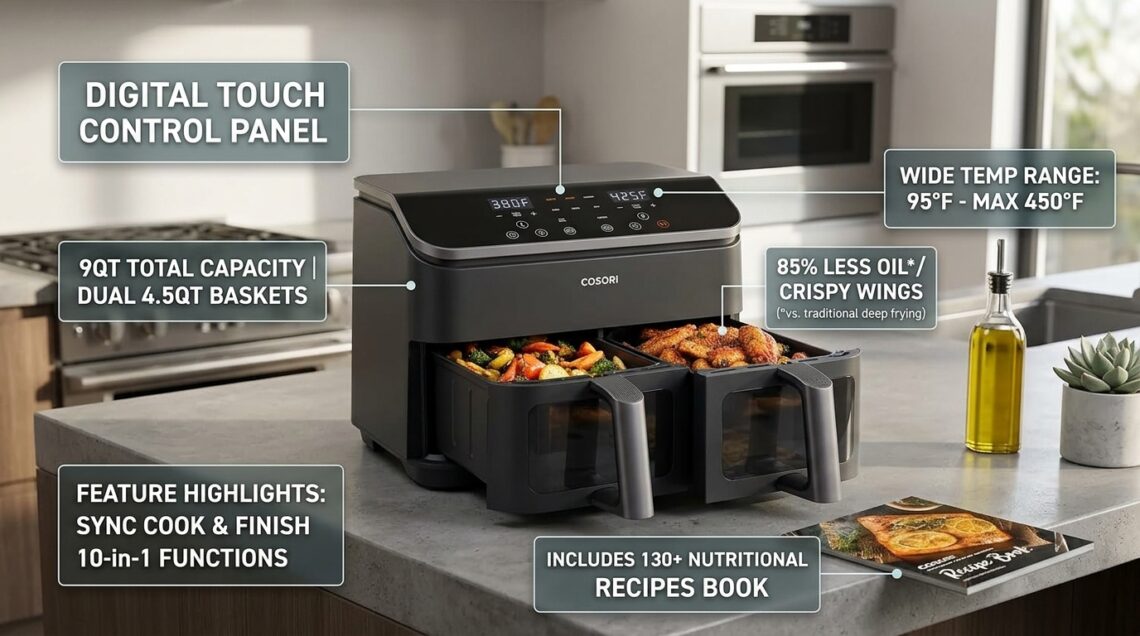
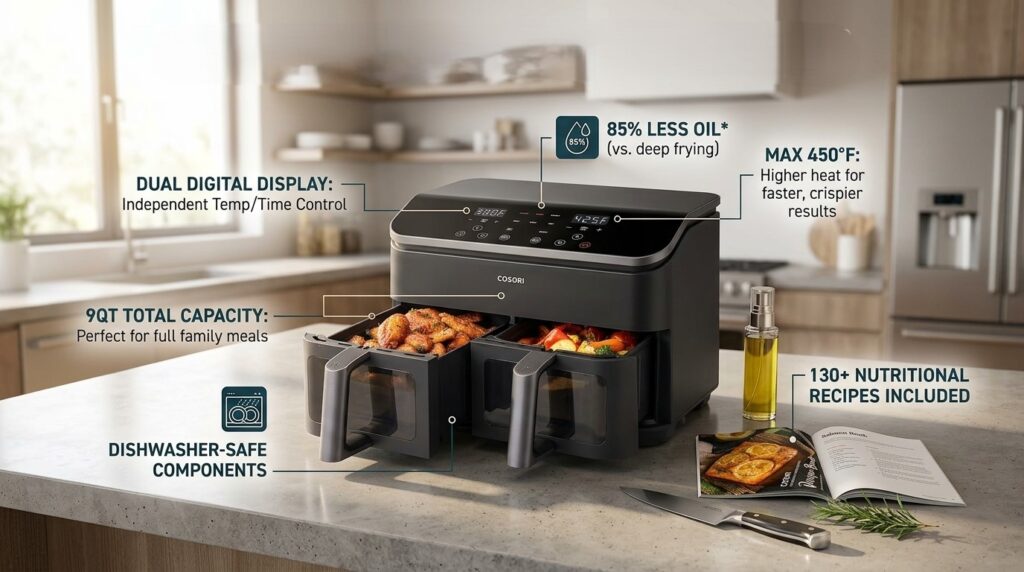
The Cosori model features two 4.5-quart baskets housed in a single unit, creating a total of 9 quarts of cooking capacity. To put this in perspective, this is roughly equivalent to eight to ten servings of fries, or enough space to cook a complete meal with multiple components simultaneously. For a family of four, this capacity proves meaningful. For households of six or more, or those who regularly entertain, the dimension becomes even more relevant.
Capacity, however, isn’t just about fitting more food in a single cooking cycle. It’s about the flexibility that comes with space. When you’re planning a meal with several components—perhaps protein in one basket and vegetables in another—the dual design offers genuine advantages in workflow and timing.
Independent Cooking Zones
What distinguishes this particular model from some alternatives is the independent cooking capability. Each basket can operate at different temperatures and for different durations simultaneously. This matters more than it might initially seem. Consider preparing a meal where chicken needs 15 minutes at 400°F while vegetables require 12 minutes at 380°F. With independent controls, you can start the vegetables later and adjust temperatures for each basket without compromise.
This independence also means you’re not locked into cooking complementary dishes at the same time. You could prepare breakfast components while simultaneously preparing components for lunch or dinner, creating genuine time savings in food preparation workflows.
Key Technical Features and Capabilities
Temperature Control Range
The temperature spectrum from 95°F to 450°F might initially seem like an unusually wide range, and it deserves explanation. The lower end of this spectrum relates to warming and proofing functions—keeping prepared foods at serving temperature without continuing to cook them, or creating the warm environment that yeast requires for bread dough to rise. While these functions won’t be used daily by most home cooks, their inclusion reflects a design philosophy that attempts to consolidate multiple appliance functions into a single unit.
The 450°F maximum represents the upper boundary of what most home cooking applications require. High-temperature cooking for crisping, searing, and achieving particular textures tops out effectively at this level. Very few home recipes demand temperatures beyond this threshold.
The 10-in-1 Function Concept
The “10-in-1” designation refers to the various cooking modes available. These typically include air frying, reheating, roasting, baking, broiling, dehydrating, grilling, steaming, slow cooking, and rotisserie functions. However, it’s important to understand that these aren’t ten entirely separate cooking methods. Rather, they represent different temperature and duration combinations, cooking zone configurations, and operational modes.
Some of these functions overlap significantly with traditional oven capabilities. Others—particularly air frying, dehydrating, and the rapid reheating cycle—represent where air fryer technology genuinely differs from conventional cooking methods. The practical value of having all these modes in one unit depends largely on how many you’d actually use regularly.
The Sync Cook & Finish Technology
This feature warrants specific attention because it represents a capability not all dual air fryers provide. Sync cooking allows both baskets to operate on coordinated timing. The “Finish” component means both baskets can complete their cooking cycles simultaneously, even if you’ve started them at different times or set them to different temperatures.
This synchronization solves a genuine problem: the coordination challenge of finishing multiple components at the same time. Rather than managing separate start times and durations mentally, the system handles the timing logic, ensuring all components reach their target doneness point together. For meal preparation, this translates directly into convenience.
Touch Control Interface
The control system uses touch technology rather than mechanical buttons or dials. This design choice affects the cooking experience in several ways. Touch controls generally take up less physical space than button panels, reducing the overall footprint of the machine. They’re also easier to clean—no crevices where food particles accumulate. However, they do require slightly more deliberate input than mechanical buttons; accidental touches are possible, though safeguards typically prevent this.
The interface needs to provide clear feedback about the current settings, temperature, and remaining time for both baskets simultaneously. How intuitively this information is presented affects day-to-day usability more than most consumers might anticipate.
Oil Reduction Claims
The claim of “85% less oil” compared to traditional deep frying refers to the fundamental cooking method difference. Air fryers circulate intensely hot air at high velocity around food, creating the texture and browning associated with oil-based frying while using minimal or no added oil. This isn’t a marginal improvement—it’s a fundamental alteration of the cooking process.
The practical implication is significant for individuals monitoring fat and caloric intake, though it’s worth noting that the texture and flavor of air-fried foods differs perceptibly from traditional deep-fried versions. Some people prefer this difference; others view it as a trade-off rather than an improvement.
Recipe Inclusion
The inclusion of 130+ nutritional recipes serves different purposes depending on your cooking experience level. For experienced cooks, the primary value might be inspiration and timing guidance for adaptation to the dual-basket format. For those newer to cooking or air frying specifically, these recipes provide structure, ingredient relationships, and baseline timing that accelerates the learning curve.
The “nutritional” designation suggests these recipes include nutritional information—calorie counts, macronutrient breakdowns, and similar data. This appeals specifically to individuals tracking dietary metrics, whether for general health awareness, specific medical conditions, or fitness-related goals.
Dishwasher-Safe Components
The designation that certain components are dishwasher-safe (typically the baskets and trays) represents a meaningful quality-of-life feature. Air fryer baskets accumulate oil residue and food particles that require regular cleaning. Dishwasher compatibility eliminates the manual scrubbing that would otherwise be necessary, particularly for the textured surfaces of the baskets themselves. However, this feature doesn’t eliminate the need to wipe down the heating element and interior chamber periodically.
Practical Applications and Cooking Scenarios
Family Meal Preparation
For families, the dual-basket configuration transforms the cooking dynamic in concrete ways. Consider a standard family dinner where you’re preparing protein and two vegetable sides. With a single-basket air fryer, you’d typically prepare the protein first, remove it to keep warm, then cook the vegetables in sequence—a process consuming 25-30 minutes or more.
With two baskets operating independently, you could begin cooking the protein at 400°F while simultaneously starting the heartier vegetables (like potatoes or carrots) at 380°F at a slightly different time, accounting for their longer cooking duration. The lighter vegetables go in later, everything finishes together, and the entire meal is on the table within 20 minutes.
This efficiency compounds across multiple cooking sessions. The reduction in total cooking and preparation time becomes apparent quickly.
Batch Cooking and Meal Prep
For individuals who dedicate specific days to meal preparation, batch cooking represents a significant use case. Modern meal prep approaches often involve cooking multiple proteins, several vegetable combinations, and various grain components that will be mixed and matched throughout the week.
The dual-basket format accelerates this workflow substantially. You’re not merely doubling your capacity; you’re improving the flow of the entire process. Prepare one component in basket one while basket two finishes the previous component. The next component starts in basket one as you remove the finished item from basket two. This rotation pattern minimizes idle time and significantly reduces overall preparation duration compared to sequential single-basket cooking.
Entertaining and Hosting
When preparing for gatherings, appetizers present a particular challenge. Many appetizers require heating just before serving to maintain optimal temperature and texture. Wings, mozzarella sticks, spring rolls, and similar finger foods need to be warm and crispy but can’t sit idle for long. The dual-basket format allows you to prepare one batch while the previous batch maintains temperature and crispness in a secondary basket, creating a continuous flow of fresh appetizers.
This scenario isn’t merely convenient; it changes what’s practically achievable for smaller-scale entertaining. Tasks that previously required oven management become far simpler.
Reheating and Temperature Management
The lower end of the temperature spectrum—the 95°F to roughly 200°F range—enables functions that most single-basket air fryers neglect. Keeping prepared components at serving temperature without continuing to cook them becomes possible. This proves particularly valuable for meal components that cook at different rates. The faster-cooking element can maintain temperature in one basket while the slower component finishes in the other.
This capability extends to events where you’re preparing components at staggered intervals but need everything available simultaneously. It’s not necessary for daily cooking, but it eliminates certain logistical challenges that home cooks typically solve through other, less elegant means.
Who This Type of Appliance Serves Well
Larger Households
Families with four or more members experience the most dramatic impact from dual-basket capacity. The time savings in meal preparation compounds with each family member added. However, even households of three find the additional capacity valuable for non-daily cooking—batch preparation sessions or occasions when entertaining.
Regular Meal Preppers
Individuals who dedicate time to batch cooking multiple components benefit substantially from the accelerated workflow that dual baskets enable. The investment in capacity and functionality aligns directly with their cooking patterns.
People with Specific Dietary Approaches
Those following low-fat or reduced-oil diets benefit from air frying’s fundamental approach to achieving texture and browning. When dietary preferences make this cooking method particularly valuable, the dual-basket format multiplies that benefit by enabling more sophisticated meal construction.
Entertaining-Focused Cooks
Individuals who regularly host gatherings or prepare food for events find the dual-basket configuration genuinely valuable for appetizer preparation, simultaneously cooking elements of multi-component dishes, and generally accelerating the overall food preparation process.
Space-Conscious Kitchen Optimizers
For those seeking to maximize functionality within limited counter space, a dual-basket air fryer represents consolidation. Instead of maintaining a single air fryer plus oven space for multiple simultaneous cooking zones, one appliance handles several scenarios. This matters less for kitchens with abundant counter space and abundant storage, but for apartments, smaller homes, or kitchen designs with limited work surfaces, the consolidation value is tangible.
Considerations Before Committing to This Style of Appliance
Counter Space Requirements
While consolidating multiple functions into one appliance provides a certain efficiency, the physical footprint of a 9-quart dual air fryer is necessarily substantial. Compared to a standard single-basket air fryer, the base dimensions are noticeably larger. It’s not a small appliance, and it will occupy meaningful counter real estate.
For some kitchens, this represents a significant trade-off. In others, it’s the solution to a space management challenge. Understanding your specific kitchen geography—where the appliance would live, how frequently it would be accessed, and what it would displace—is important before purchasing.
Learning Curve with Multiple Functions
While air frying itself has a modest learning curve, understanding the full range of available functions, which ones actually serve your cooking patterns, and how to achieve desired results with each mode requires some experimentation. The recipe inclusion helps, but exploration will still be necessary.
This isn’t a prohibitive factor—most appliances require learning—but it’s worth acknowledging. You won’t use every function immediately or necessarily ever. Some functions (like slow cooking) essentially replicate dedicated appliances. Recognizing which features genuinely serve your needs versus which represent nice-to-have capabilities helps establish realistic expectations.
Temperature and Duration Variations Between Baskets
While independent temperature control provides flexibility, it also requires attention. Different foods cooked simultaneously might require different temperature management. Creating a mental model of which components cook at which temperatures, for how long, and when to start each one requires slightly more planning than single-basket cooking.
For most cooks, this planning becomes intuitive quickly. But it’s a marginal increase in cognitive load, particularly when new to this cooking method.
Cleaning and Maintenance
Although dishwasher-safe baskets eliminate one major cleaning task, the interior chamber, heating element, and non-removable surfaces still require periodic cleaning. Grease and food particles accumulate despite the appliance’s efficiency. The machine requires regular attention to maintain optimal performance and prevent odor accumulation.
This is true of all air fryers but worth noting. It’s not a significant burden—wiping the interior with a damp cloth takes minutes—but it’s not maintenance-free.
Contextualizing Dual-Basket Air Fryers in the Broader Appliance Landscape
Comparing to Single-Basket Air Fryers
The primary trade-off is space for capacity and convenience. Single-basket models occupy less counter space and typically cost less upfront. They handle everyday cooking for individuals or couples adequately. However, they don’t provide the cooking efficiency or versatility that dual baskets offer for larger households or complex meal scenarios.
The choice hinges on usage patterns. Light users might find the additional capacity unnecessary. Regular cooking for multiple people makes the upgrade meaningfully valuable.
Compared to Convection Ovens
Convection ovens provide substantial capacity and multitasking capability. However, they require preheating time and achieve browning and crispness through different mechanisms than air fryers. Air fryers create particular textures and outcomes that convection ovens, even high-quality ones, don’t replicate.
For specific applications—particularly achieving crispy textures rapidly without substantial oil—air fryers excel. Convection ovens provide more gradual, gentle heat. Both have legitimate uses; they’re not direct substitutes.
Compared to Dedicated Multicookers
Devices combining slow cooking, pressure cooking, and other functions provide diversity of cooking methods. However, they typically don’t excel at the air frying function itself—the rapid air circulation and texture development that make air fryers specific. Conversely, air fryers handle slow cooking and some other multicooker functions less effectively than dedicated multicookers.
If your primary need is diverse cooking methods, a multicooker might prove more valuable. If air frying represents your central need with complementary functions as secondary, the air fryer approach makes more sense.
Frequently Asked Questions
How much counter space does this appliance actually require?
A 9-quart dual air fryer typically measures roughly 20-22 inches wide, 15-17 inches deep, and 10-12 inches tall, though exact dimensions vary by manufacturer. It’s substantially larger than a toaster but somewhat smaller than a traditional microwave. Measure your intended placement before purchasing to confirm it fits your kitchen layout.
Can the baskets be used independently, or must both operate together?
This model’s design enables independent operation. Each basket has its own heating element and can run at different temperatures and durations. However, some operational modes might require both baskets to be in use simultaneously. Reviewing the specific operational specifications clarifies any restrictions.
Does the machine really reduce oil usage by 85%?
This claim compares air fryer cooking to traditional deep frying in oil. Air fryers circulate intensely heated air to achieve browning and texture without submersion in oil, which is why the oil reduction is substantial. However, this comparison is to deep frying specifically. Compared to oven-cooking methods, the oil reduction difference is less dramatic. The more meaningful consideration is whether you typically deep fry foods and would consider reducing that practice.
Are the recipes included comprehensive enough to avoid consulting other sources?
The included 130+ recipes provide starting points and inspiration, but they’re not a complete cooking reference. You’ll likely consult additional recipes and resources, particularly as you explore which types of foods work best in the air fryer and develop your personal preferences for preparation methods.
How does the synced cooking feature actually work in practice?
The sync feature allows you to set both baskets to finish at the same time, even if they’re running at different temperatures or started at different times. You input target completion time, and the system manages the timing internally, starting the faster-cooking component appropriately later than the slower component. This eliminates the need to manually calculate staggered start times.
Can you cook an entire meal for a family of four simultaneously?
Absolutely. The dual baskets provide sufficient capacity for protein in one basket and vegetable sides in the other. Grains or starches might be prepared using a different method simultaneously, or you could prepare components in sequence, using the warming function in one basket while the next component cooks in the other.
What happens if one heating element fails?
The unit should still operate, though at reduced capacity. A single basket would continue functioning independently. However, this represents an operational degradation, and repair would be advisable for optimal performance. Warranty coverage would apply depending on the manufacturer’s specific terms.
Is the learning curve steep for someone new to air frying?
Air frying is fundamentally straightforward: add food, set temperature and duration, wait. However, learning ideal temperatures and timings for specific foods requires experimentation. The included recipes accelerate this process significantly. Most cooks develop proficiency within several weeks of regular use.
How often does the appliance need internal cleaning?
Regular wiping of interior surfaces after cooking prevents grease and residue accumulation. Weekly or bi-weekly cleaning (literally wiping with a damp cloth) maintains optimal performance and prevents odor issues. Monthly more thorough cleaning ensures longevity.
Making the Decision: Is This Right for Your Kitchen?
Evaluating whether a dual-basket air fryer serves your needs requires honest assessment of your actual cooking patterns, kitchen constraints, and culinary preferences. These appliances genuinely excel for certain scenarios and usage patterns, but they’re not universal solutions.
Consider purchasing this style of appliance if you regularly cook for four or more people, engage in meal prep activities, entertain frequently, or find that single-basket capacity regularly constrains your cooking workflow. The dual-basket format will demonstrably improve your efficiency and versatility in these situations.
Conversely, if you primarily cook for one or two people, rarely use specialized cooking functions, or face genuine counter space limitations, a more compact appliance might better serve your situation. Honest assessment prevents overspending on features you won’t use.
Conclusion
The Cosori 9QT Dual Air Fryer represents a particular approach to modern cooking appliances—one that acknowledges the growing relevance of air frying as a cooking method while providing the capacity and functionality that larger households and diverse cooking scenarios require. It’s not an appliance for everyone, but for the households it serves, it meaningfully improves cooking efficiency, enables more sophisticated meal construction, and provides versatility that single-basket models can’t match.
Understanding the specific capabilities—the independent cooking zones, the temperature range, the dual-basket architecture—allows you to evaluate whether these features align with your actual cooking practices. The honest assessment of your kitchen space, regular cooking patterns, and culinary needs matters far more than marketing claims or feature lists.
If this model’s capabilities match your requirements, exploring more details can help you make an informed decision. You can check more details on Amazon here to review current customer feedback and specifications, which provide practical insights from users who have integrated this appliance into their daily cooking routines.