Introduction
Air fryers have fundamentally changed how many people approach weeknight cooking. They’ve made crispy foods achievable in minutes without the mess of traditional frying, and they’ve done so in a way that fits reasonably into most kitchens. However, not everyone has the counter space for a full-sized appliance. This is where compact air fryer models enter the conversation—they offer genuine cooking capability without commanding the real estate of their larger counterparts.
The Bella 4Qt Slim Air Fryer represents a particular approach to the compact air frying category. Rather than trying to do everything, it focuses on delivering straightforward functionality in a footprint designed to slide into tight spaces. Understanding what this model can and can’t do helps you determine whether it aligns with your cooking habits and kitchen setup.
What Makes This Model Different
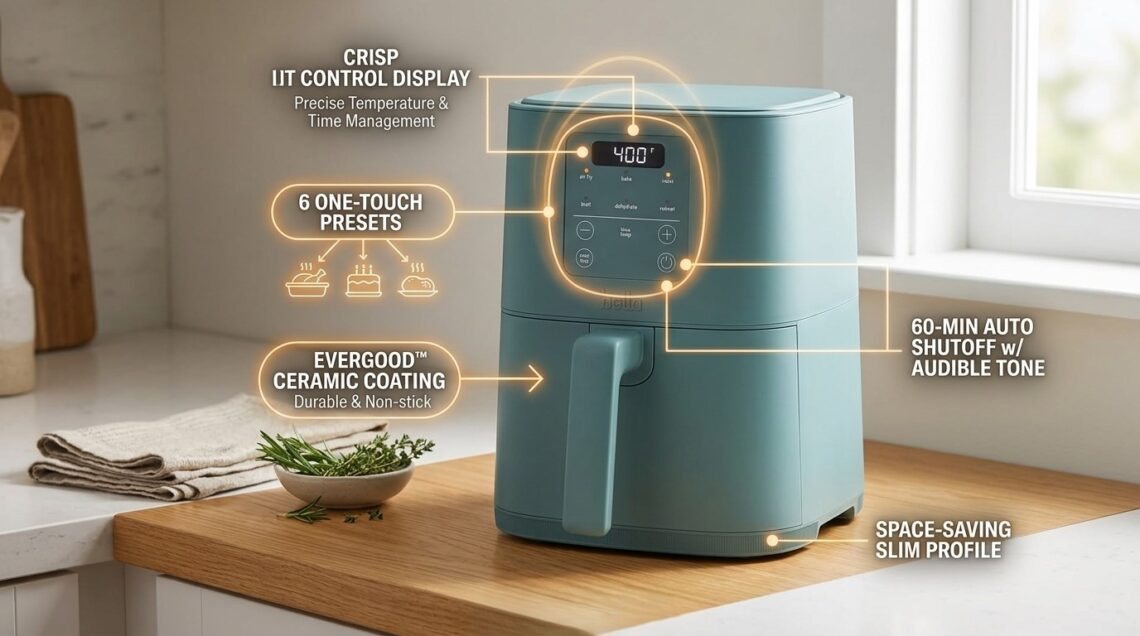
The defining characteristic of this Bella unit is its slim profile, which is intentional. Manufacturers face a trade-off when designing compact appliances: they can maintain traditional dimensions and reduce interior volume, or they can maintain interior capacity while thinning the overall footprint. This model opts for the latter approach, which means you get a reasonably sized cooking chamber despite the slender exterior.
The 4-quart capacity sits in the middle ground of the air fryer spectrum. It’s not a personal-sized device, but it’s noticeably smaller than the sprawling 6-quart units you’ll find taking up considerable counter space. This matters if you’re cooking for a household of two to four people and want something that doesn’t completely dominate your workspace.

Key Features Explained
Ceramic Nonstick Coating
The use of EverGood ceramic nonstick coating is worth understanding beyond the marketing language. Ceramic coatings differ from traditional Teflon-based nonstick surfaces in several meaningful ways. They’re generally more resistant to scratching, which means your air fryer basket can handle more aggressive cleaning without degrading. They also tend to be more heat-stable at higher temperatures, which matters in an appliance where temperatures reach 400 degrees Fahrenheit and beyond.
Ceramic coatings do require some maintenance to preserve their nonstick properties. Hand washing is typically recommended rather than throwing the basket in the dishwasher, even if the manufacturer claims dishwasher compatibility. This isn’t a major inconvenience—it’s simply the reality of nonstick cookware, whether air fryer baskets or traditional pans.
Adjustable Temperature Control
Temperature flexibility is essential for air frying because different foods require different heat levels. Vegetables might cook best at 375 degrees, while chicken skin becomes more satisfyingly crispy at 400 degrees. Frozen foods sometimes benefit from slightly lower temperatures with extended cooking times to ensure centers are thoroughly heated.
Having adjustable temperature means you’re not locked into preset conditions. You can dial in precisely what your recipe or technique requires rather than accepting whatever one-size-fits-all setting the appliance offers.
Six Preset Cooking Options
Preset functions serve two purposes. First, they reduce decision fatigue for people who’d prefer simple push-button cooking over adjusting time and temperature manually. Second, they’re typically calibrated by the manufacturer to work well with common foods—frozen fries, chicken wings, vegetables, and similar items.
The practical value of presets varies by person. Some users reference them constantly, while others ignore them completely and adjust settings manually each time. Neither approach is wrong; it depends on your cooking style and whether you prioritize convenience or customization.
Auto Shutoff with Audible Alert
The 60-minute auto shutoff timer serves an important safety function. It prevents you from accidentally leaving the appliance running for extended periods, which both wastes energy and poses a potential fire hazard if anything flammable is nearby. The audible tone means you won’t have to watch the display constantly—you’ll hear when cooking time has elapsed.
In practice, this feature is most valuable during your adjustment period as you learn cooking times for your favorite foods. Once you’ve developed a rhythm and know that your homemade potato fries need exactly 18 minutes, you’re less likely to forget about the timer anyway. Still, having the automatic shutoff provides a safety net.
Capacity Considerations
A 3.3-pound capacity gives you meaningful cooking volume without being oversized. You could comfortably prepare:
- A whole chicken (roughly 3 to 3.5 pounds)
- Two medium salmon fillets plus roasted vegetables
- A full batch of homemade french fries
- A Sunday breakfast for four people (multiple portions of hash browns, bacon, or sausage)
- Side dishes for an average family meal
What you couldn’t reasonably do is prepare multiple complete meals simultaneously or feed a large gathering using only this fryer. If you’re cooking for six or more people regularly, or if you meal prep by cooking enormous batches, you’d likely find yourself wishing for more capacity.
Practical Uses and Cooking Applications
Everyday Weeknight Dinners
The most common use case for compact air fryers is streamlining weeknight meal preparation. Quick proteins like chicken thighs or salmon fillets cook in 12 to 15 minutes. You can prepare vegetables simultaneously using the same basket (or in batches if you prefer different temperatures). Compared to preheating a full oven and waiting 20 to 25 minutes, this represents genuine time savings.
Frozen Foods and Quick Meals
Air fryers excel at handling frozen items because the intense circulating heat helps cook interiors while crisping exteriors. Frozen vegetable medleys, fishcakes, or breaded proteins all emerge in better condition from an air fryer than from traditional oven reheating. The time savings matter here—you’re talking about 8 to 10 minutes instead of 15 to 20.
Vegetable Preparation
Roasted vegetables are straightforward in air fryers. Broccoli, Brussels sprouts, carrots, and similar items develop color and texture quickly due to the concentrated heat. The main consideration is not overcrowding the basket, which blocks proper air circulation. This often means cooking vegetables in batches if you’re preparing sides for multiple people.
Reheating Leftovers
This might be the underrated advantage of air fryer ownership. Leftover pizza returns to crispness. Fried chicken doesn’t dry out. Roasted potatoes regain their texture. The results consistently outperform microwave reheating, and they’re faster than conventional oven warming.
Experimenting with New Cooking Methods
Air fryers encourage people to experiment with techniques they might not otherwise try. Making homemade potato chips becomes manageable. Tofu crisping becomes achievable. Hard-boiled eggs become faster. Not every experiment works equally well, but the barrier to trying is lower than with other cooking methods.
Who Might Find This Appliance Useful
Urban Dwellers and Apartment Residents
Space constraints are the primary reason many people consider compact air fryers. If your kitchen lacks a dedicated countertop or your storage is limited, a slim profile makes a meaningful difference. You can position this appliance next to your microwave or coffee maker without it completely blocking your counter.
Small Households
People cooking for one or two benefited tremendously from full-sized air fryers, but the extra capacity often went unused. A 4-quart model matches actual cooking needs without overcommitting to appliance size. You get adequate capacity without wasting energy or space on unnecessary volume.
People Seeking Faster Cooking
If your primary motivation for an air fryer is speed—wanting to move from frozen or raw to cooked in minutes rather than half an hour—this model delivers on that promise. The compact size doesn’t compromise cooking speed; if anything, smaller volumes of air heat slightly faster.
Health-Conscious Cooks
Air frying uses significantly less oil than traditional deep frying while still achieving crispy results. If you’re focused on reducing oil consumption or preparing fried-style foods with less fat, an air fryer facilitates that goal.
Kitchen Gadget Minimalists
Some people deliberately keep their kitchen appliances to a lean collection. A compact air fryer that serves multiple purposes—crisping, roasting, reheating, toasting—can reduce the total number of appliances while still covering those functions.
Important Considerations Before Purchasing
Space vs. Capacity Trade-offs
While the slim design is convenient, it does mean you’ll occasionally bump up against capacity limits. If you frequently cook for more than four people, or if you batch-cook extensively, you might find yourself wishing for more room. Consider your realistic cooking patterns before committing.
Learning Curve for Timing
Air fryer cooking times vary more than conventional oven cooking based on several factors: the model’s actual heating efficiency, the starting temperature of your ingredients, how densely you pack the basket, and even your local elevation. You’ll need to experiment for the first few uses. The appliance’s preset functions help with this, but don’t expect restaurant-perfect results immediately.
Maintenance Requirements
Ceramic nonstick coatings require care. Avoid metal utensils that might scratch the surface. Hand wash rather than using harsh dishwasher cycles. These aren’t onerous requirements, but they do mean the basket needs more attention than typical cookware.
Noise Level
Air fryers generate noise—the sound of powerful fans circulating air continuously. If your kitchen opens onto a bedroom or quiet living space, this might be worth considering, especially if you cook early mornings or late evenings.
Storage of the Basket
The basket needs somewhere to live when not in use. Some people store it inside the air fryer body, while others prefer to keep it separate. Make sure you have a logical place for it before the appliance arrives.
How Air Fryer Technology Compares Broadly
Air Fryer vs. Convection Oven
Convection ovens move hot air similarly to air fryers, but air fryers achieve higher air velocity in a more concentrated space. This typically results in faster cooking and more pronounced browning. Convection ovens offer more capacity but require longer preheating times. If speed matters more than volume, the air fryer has an advantage.
Air Fryer vs. Toaster Oven
Compact toaster ovens occupy similar counter space but offer broader functionality—you can toast bread, bake cookies, or roast vegetables. Air fryers specialize in one thing and do it faster. Which is better depends on whether you value versatility or specialization.
Air Fryer vs. Traditional Oven
Traditional ovens excel at volume and hold multiple dishes simultaneously. Air fryers excel at speed and efficiency. Most homes benefit from having both—using the traditional oven for batch cooking and the air fryer for quick meals.
Air Fryer vs. Stovetop
Stovetop cooking remains essential for sauces, pasta, and many other dishes. Air fryers can’t replicate what a stovetop does, but they’re faster and less hands-on for foods like vegetables, proteins, and anything else needing crisping or roasting.
Frequently Asked Questions
What size air fryer should I choose?
Your household size and cooking habits matter most. A 4-quart model works well for households of two to four people preparing regular meals. Larger households or anyone batch-cooking should consider going larger.
Does the ceramic coating eventually wear out?
Ceramic nonstick coatings degrade gradually with use. You might notice stickiness increasing after one or two years of regular use. This doesn’t make the appliance unusable—food just requires slightly more oil or cooking spray to prevent sticking.
Can I cook multiple foods at different temperatures simultaneously?
Not in this model. You’re working with one basket at one temperature. If recipes require different heat levels, you’ll need to cook in batches.
How much counter space does a slim air fryer actually save?
A traditional air fryer might occupy 8 by 10 inches; a slim model might be 5 by 8 inches. The depth typically remains similar. If counter space is extremely tight, this difference is noticeable. If you have moderate constraints, it’s helpful but not life-changing.
What’s the learning curve for cooking times?
Expect to experiment for your first two to four cooking sessions before developing reliable timing instincts. By ten uses, you’ll have internalized timing for your most-cooked items.
Is preheating necessary?
Most recipes suggest brief preheating (3 to 5 minutes), though the appliance operates differently than traditional ovens. Some dishes taste better with full preheat; others don’t require it.
How loud is it?
Air fryer noise typically ranges from 65 to 75 decibels—comparable to a normal conversation or an average microwave. It’s noticeable but not exceptionally loud.
Can you stack foods in the basket?
Stacking can block air circulation, resulting in uneven cooking. Most experts recommend arranging foods in a single layer when possible. If stacking is necessary, flip foods halfway through cooking to ensure even results.
Final Thoughts
The Bella 4Qt Slim Air Fryer represents a straightforward value proposition: compact size without sacrificing meaningful capacity, straightforward controls with optional preset functions, and ceramic nonstick coating designed for durability. It’s not an attempt to reinvent air frying or introduce revolutionary features. Instead, it’s a practical implementation of proven air frying technology in a form factor that suits people with space constraints.
Whether this model matches your needs depends on your household size, available space, and cooking habits. If you’re feeding two to four people, work with limited counter space, and value quick meal preparation, it’s worth exploring further. If you regularly cook for six or more people or prefer your kitchen appliances to multitask extensively, you might benefit from reconsidering.
The air frying method itself—rapid air circulation cooking—has demonstrated practical value across millions of households. This particular model simply delivers that method in a more compact format, which is neither inherently better nor worse than full-sized alternatives; it’s simply different in ways that matter to different people.
You can check more details on Amazon here to see the current availability and any customer discussions that might further inform your decision.